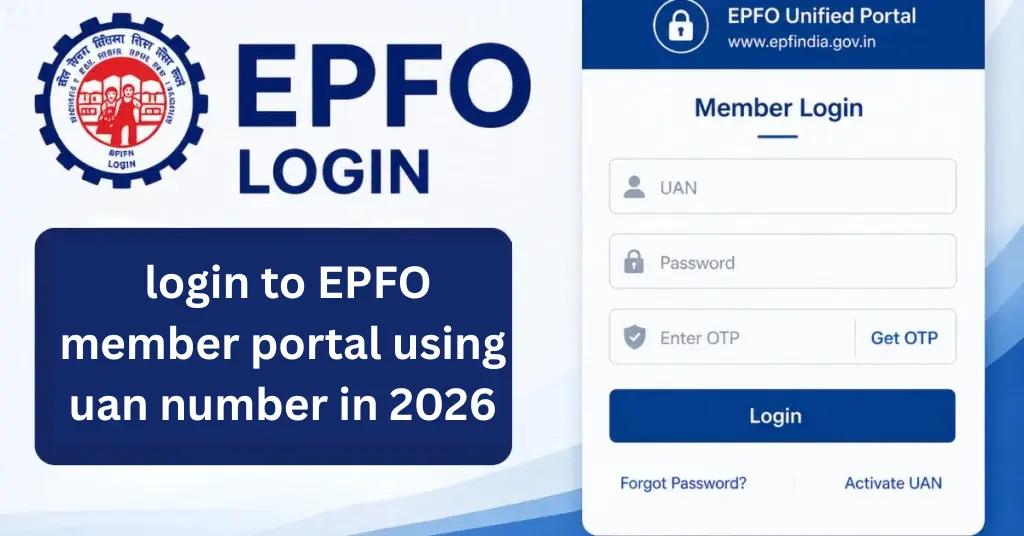
login to EPFO member portal using uan number in 2026
EPFO Employer Login member portal using uan number in 2026 Provident Fund Organisation (EPFO) provides millions of salaried employees in India with access to their provident fund accounts through the EPFO Member Portal. This portal allows members to check PF balances, download passbooks, track claims, update KYC details, transfer PF accounts, and manage various EPF-related services online. To access these services, members need their Universal Account Number (UAN), which acts as a unique identifier throughout their employment journey.
In 2026, the EPFO Unified Member Portal continues to be the primary platform for EPF account management. Additionally, EPFO has introduced some changes regarding UAN activation, including Aadhaar-based Face Authentication through the UMANG app. Understanding the login process can help members access their EPF information quickly and securely.
UAN Important
Activate UAN Without Employer Assistance Universal Account Number number assigned to every EPF member by EPFO. It remains the same throughout an employee’s career, even when changing jobs. Multiple Member IDs from different employers can be linked under a single UAN, making PF management easier and more transparent. Without UAN activation and login access, many of these online services cannot be used.
Benefits of Using the EPFO Member Portal
Members can access their PF information anytime without visiting an EPFO office. Online claim submission helps reduce paperwork and speeds up processing.
Users can update Aadhaar, PAN, bank account details, and other KYC information online. The portal centralizes all EPF-related services in one place.
If your UAN is not activated yet, activation may now be completed through Aadhaar-based Face Authentication on the UMANG app.
Open the official EPFO Unified Member Portal and navigate to the Member e-Sewa login page. In the login section, enter your 12-digit Universal Account Number (UAN).
Complete OTP Verification
In some cases, EPFO may send a One-Time Password (OTP) to your registered mobile number as an additional security step. Enter the OTP to complete login.
If your UAN is not activated, EPFO has updated the activation process. Direct UAN activation through the member portal has been discontinued. Members can now activate their UAN using Aadhaar-based Face Authentication through the UMANG mobile application.
- EPF passbook
- Claim status
- Online claims
- KYC management
- Service history
- UAN card download
Aadhaar number
Registered mobile number
Personal details matching EPFO records
Common Login Problems and Solutions
Use the “Forgot Password” option available on the login page to reset your password through OTP verification. Never share your password with anyone.
Use only official EPFO portals.
If multiple incorrect login attempts lock your account, use the “Unlock Account” feature. Keep your registered mobile number updated.
Enable OTP verification whenever available.
Ensure your registered mobile number is active and linked to your UAN. Regularly review your PF account activity. These practices help protect your retirement savings and account information.
Activate your UAN through the UMANG app before attempting login.
Frequently Asked Questions
Final Thoughts
The EPFO Member Portal remains one of the most important digital platforms for salaried employees in India. By logging in with your UAN number, you can conveniently manage your provident fund account, monitor contributions, update personal information, and submit claims without visiting an EPFO office.
The portal significantly simplifies retirement fund management while providing transparency and easy access to essential services.
As EPFO continues to modernize its services in 2026, including Aadhaar-based Face Authentication and improved digital tools, members can expect an even smoother experience. Keeping your UAN activated, maintaining updated KYC details, and using the official EPFO platforms will help you maximize the benefits of your provident fund account and stay in control of your long-term savings.